

The Robber Baron and the Radical
Our first guest essay. Plus, some updates from across the pond.

Greetings from London. Earlier this week I was interviewed on Al Jazeera and participated in the Doha Debates. More on that soon. Stay tuned!
I’m also excited to announce that we’re now accepting submissions for guest essays. If you have a draft, reach out and we’ll take a look. We plan to publish subscriber-submitted essays on a limited basis.
Our very first guest essay was written by Brooklyn-based woodworker Darren Gardner. Enjoy!
- Catherine
The Robber Baron and the Radical
By Darren Gardner
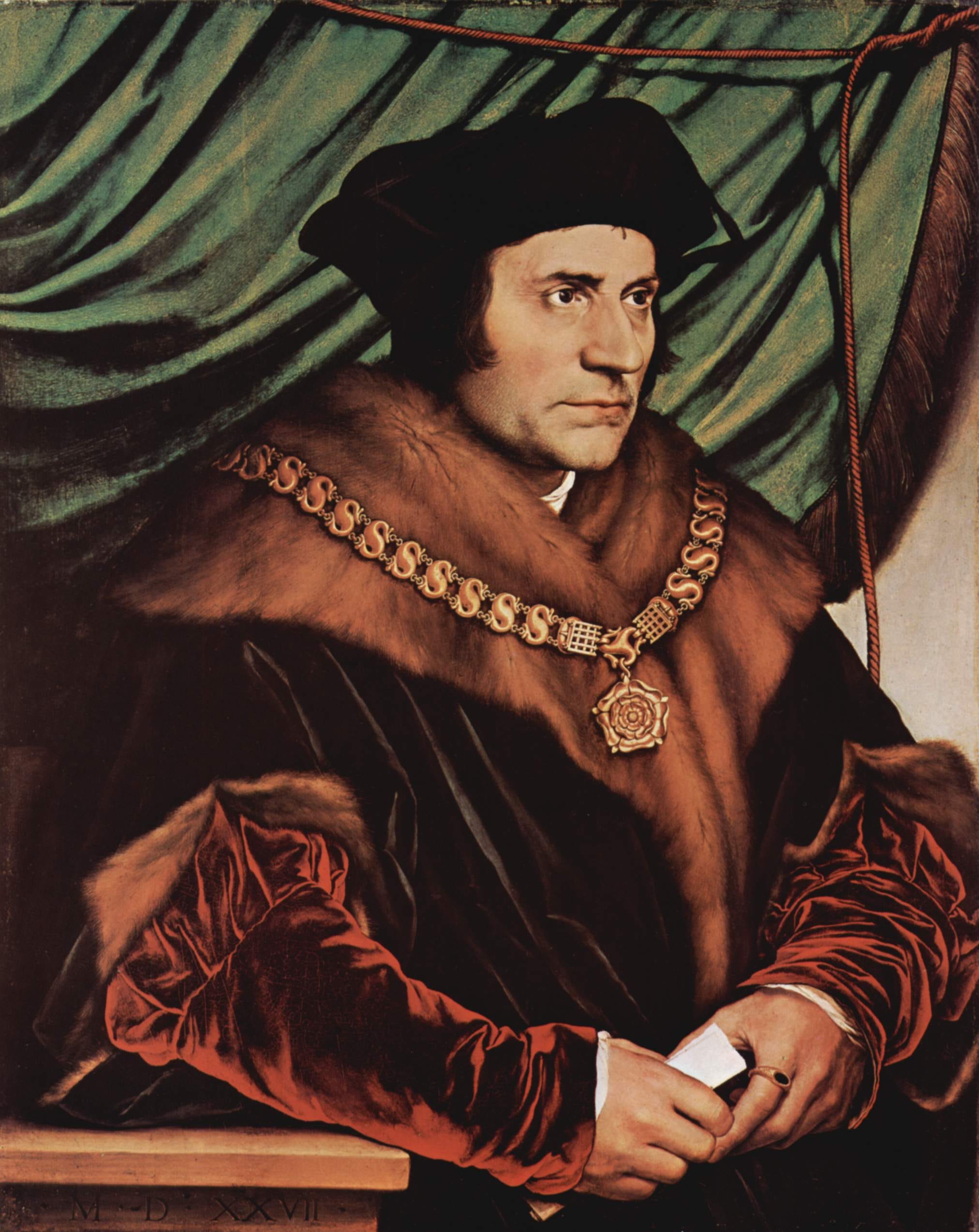
On a cold winter afternoon in NYC, seeking a warm respite, I found myself at The Frick Collection, newly reopened after a major renovation. My memory of Turner, Vermeer, and Rembrandt had guided me there, and the splendor of these masters did not disappoint. But it was something else that grabbed my attention: the Portrait of Thomas More (1527), by Hans Holbein the Younger. He stares obliquely out from his portrait as if avoiding our gaze, adorned in regal garb. One might walk past More without much thought; after all, he appears to fit the decor – a powerful Tudor in a lush velvet robe matching the voluptuousness of the room. But Holbein is a master, and More cuts a very sophisticated figure.
The author of Utopia (1516), More argued that the root of evil lay in private ownership and that gold was best used for chamber pots because of its worthlessness. Ironically, Holbein’s portrait of More has resided for decades in the former home of Henry Clay Frick, the capitalist robber baron. What would they say to each other? In Utopia, More argued against the inequality of his time: “wherever you have private property, and money is the measure of all things, it is hardly possible for the commonwealth to be justly governed or to flourish in prosperity.”1 By contrast, Frick made a fortune in steel and responded to the basic demands of workers with disdain, anti-union tactics and direct violence.
Consider Frick’s involvement in the 1892 Homestead strike. When workers went on strike for better wages and worker safety, it fell to Frick to address the unrest and restore productivity. His response was to hire three hundred Pinkerton detectives with Winchester rifles. On July 6, the Pinkertons arrived by barge, but because the strikers had been warned, they came prepared to meet force with force. The bloody confrontation of a private security force against working Americans ended with the loss of seven workers and three Pinkertons. Frick defeated the workers, and the union was broken.
For More, this might have seemed an inevitable clash. He suggests that private ownership and concentrated power over workers are a recipe for unrest, and that commonwealths in his day that appear to flourish are ‘common-wealth’ in name alone. “When I consider and turn over in my mind the state of all commonwealths flourishing today, so help me God, I can see nothing else than a conspiracy of the rich, who are advancing their own interests under the name and title of the commonwealth.”2
The museum, of course, says nothing about Utopia’s powerful views on private property. The audio guide notes More’s eventual sainthood and how he was beheaded by Henry VIII for refusing to acknowledge the King’s supremacy over the church. But it does not mention Utopia. It does not acknowledge that More envisioned a society where everything Frick stood for would be abolished.
Frick proudly displayed his acquisition, but did he see it as a commodity, a masterwork for a collection without recognizing the ideology that such a figure stood for? Or was the purchase of the portrait a kind of victory over the ideology of shared resources and redistribution in Utopia? The private display of such art, particularly by titans of industry, reflects a desire to own great works; such a display of power and exclusivity is matched only by the royalty that Holbein often served. And the painting hangs there not because the museum endorses More or publicizes his humanism, but because Holbein is a master, a draw for the many travelers to marvel at, essentially glossing over everything he stood for.
Such a gloss, where aesthetic sparkle can obfuscate deeper meanings, appeared again when I returned home and came across Ezra Klein’s New York Times column comparing Donald Trump’s governing style to the anarchist idea of the “propaganda of the deed.” Klein argued that the Trump administration operates through spectacular acts like mass deportations and problematic military incursions rather than through the rule of law and public bureaucratic processes. Apparently, he muses, spectacle is a propaganda of the deed. To illustrate this thought, Klein reached for a historical parallel, but I think he reached for style over substance. The anarchists of the late 19th century did believe, but only for a short time, that an act of violence could galvanize the working class. But this was not intended as spectacle, but rather as a reaction to oppression and a flawed but sincere form of solidarity.
Klein’s analogy may seem seductive, but it is wrong. Not because Trump doesn’t govern with the use of spectacle from power, but because Klein uses an anarchist idea the way that Frick uses More’s portrait: stripped of its political content and depth and reduced to an aesthetic device.
The anarchist use of attentat or the propaganda of the deed was a specific tactical response to a set of conditions: a state that used violence to protect capital, and workers who had no other means of resistance. Emma Goldman, Johann Most, and Alexander Berkman, great anarchists of turn-of-the-century New York, didn’t advocate a kind of theater – they fought for solidarity.
On July 23, 1892, just a few weeks after the Homestead massacre, Alexander Berkman walked into Frick’s Pittsburgh office with a revolver. He shot Frick and stabbed him. Astonishingly, Frick survived. Berkman was arrested, tried, and sentenced to twenty-two years in prison, where he wrote Prison Memoirs of an Anarchist (1912), which includes not only a critique of the American penal system but Berkman’s maturing thoughts on the use of violence and his turn away from the propaganda of the deed.
Berkman’s assassination attempt was not random violence and certainly not mere spectacle. It was a response to Homestead. The attentat was intended to challenge men like Frick directly, who otherwise would appear above the law and beyond reproach.
The assassination attempt failed. It failed tactically and strategically: Frick survived and was stronger than ever, and the anarchist movement lost credibility and momentum. The American labor movement did not rally to Berkman’s cause, and public opinion soured on anarchist views. Within a few years, anarchists including Berkman himself not only reconsidered the propaganda of the deed, but also continued to develop new ideas for effective labor organizing, education, and collective action. Attentat was never a fully mature idea, let alone a sustained view for Berkman.
This is what Klein’s analogy gets wrong. To compare this to Trump’s theatrics, his extrajudicial cruelty performed for ego and applause is not just historically inaccurate, it is appropriation. Klein takes the language of a solidarity movement, even a flawed one, that fought for basic worker rights and repurposes it to explain authoritarian state power, and in doing so, the propaganda of the deed becomes like a portrait stripped of the content of its subject.
Perhaps it is easier to have our political and philosophical thinkers dead, framed, gilded, and on display, particularly if they held ideas that might challenge the status quo arrangements of power and labor. But More, Goldman, and Berkman didn’t risk their lives so we could admire them as mere figures, or flatter our own virtue by placing their books on our shelves without reading them. If, as a society, we agree that one should read political and philosophical works, in this case the humanists and the anarchists (both of whom argue for a form of human dignity and equality), we ought to engage with them over and above a commodity fetish like hanging great works in private mansions or libraries. If we must be collectors, let us be collectors of ideas, and let us share them until such time as More and Berkman are seen as visionary rather than radical.
Darren Gardner is a woodworker in Brooklyn, NY, and holds a PhD in Philosophy from the New School for Social Research.
Thomas More, Utopia, ed. George M. Logan and Robert M. Adams, rev. ed. (Cambridge: Cambridge University Press, 2002), 37.
More, Utopia, p.105
W/r/t “Propaganda of the Deed”, in the future we may perhaps ask ourselves, “do you remember where you were when Brian Thompson was shot?” I certainly do, because we were all in a car with a big Dem donor on our way to dinner, and we were all enjoying discussing first the immediate popular reaction—which was you may recall an emphatic “fuck that guy!”—and then the Dem reaction which was an absolute refusal (in an election year!) to seize the moment and make ANY kind of political use of the event.
Because here was an issue that was actually “bipartisan”—EVERYBODY hates insurers! It would have been easy (so, so easy!) for the Dems to do something (anything!) with it. But of course you knew that they would do exactly what they did in fact do: which was to (1) do nothing and then (2) pat themselves on the back for their inaction.
W/r/t Ezra Klein, I would expect nothing less from our leading liberal “public intellectual” to not know any history and for that reason get propaganda of the deed exactly backwards. The only question is, whether he and the NYT are really so stupid as to not know the difference between state-sponsored terror and anarchist direct action, or whether they are deliberately misleading their readership. I think the answer to this is probably that they simply don’t know the difference. I suspect that for them “propaganda of the deed” is just something that sounds bad, something from the bad old-timey times, and therefore why bother contextualizing it?
Great essay. Klein's lack of historical context is not surprising. From his perch, what he sees on the streets and campuses is the performative acting out of a pseudo-left. The "resistance" today is in no way analogous to the lethal conflict unleashed by by capital in Homestead Pa., Coeur d'Alene Idaho, or Ludlow Colorado. Anarchists and union leaders like Big Bill Heywood were literally fighting for their lives, not looking to create spectacle.