

Wizards: a Historical Ethnography of the Auto Shop Floor
Our second guest essay.



Greetings from Paris! Thank you for joining me for my livestream over the weekend. If you missed it, you can find it here.
This week we have a brilliant guest post by two writers in Alabama, Zac Hyden AKA The Mad Redneck and Graham Ingram. Zac is an auto technician and organizer, and Graham works as a political consultant in Alabama politics. Together, they run Next South Strategy.
We hope this piece will be the first of many guest posts about what it is like to work for a living in 2026. Please send queries and submissions to matt@cliuanon.com.
- Catherine
Wizards: a Historical-Ethnography of the Auto Shop Floor
By Zac Hyden and Graham Ingram
Zac Hyden has been an automotive technician off and on since he was 18 years old. He started out at a small shop in Huntsville, Alabama called Stringfellow Auto Repair. He has always loved automotive technology, but has become increasingly convinced that the automotive industry must undergo a revolutionary transformation, with a total reevaluation of everything from business models to shop floor organization to consumer education. It is a time fraught with traps, but also opportunities. He has worked at independent shops, dealerships, and he even ran a non-profit shop for five years called The Automotive Free Clinic that repaired vehicles for disadvantaged people at cost. Graham is the grandson of car dealership owner Jack Ingram and has numerous family members involved in the automotive industry. Zac and Graham wrote this essay collaboratively, based on Zac’s experiences as an auto technician. Graham was responsible for the social history of the automobile, and Zac was responsible for the research on technicians.
Zac’s experience posed a few questions. 1. Why are automotive technicians so stressed out? 2. Why, nearly across the board, does the public distrust automotive shops? And 3. What historical factors have created the conditions that lead to poor mental health in technicians, and distrust of shops among the public.
The central argument in our essay is that automotive repair shops are expected to repair not just vehicles, but also the societal crisis in transit and mobility. This is a mandate that they are ill-positioned and ill-equipped to address, and places an unfair burden on them as skilled and responsible workers.
This essay begins with a condensed ethnography of the Auto Shop Floor. It is followed by a brief social history of the automobile, which gives context to the operations of both technicians and shops.
We use five automobiles to define the eras of American mobility development: the Model T, the Chevrolet Bel Air, the Honda CVCC, the Toyota Corolla, and the Tesla Model S. The design of each of these vehicles reflects the policy and planning environments of their times. They each represent a singular choice to create a car-dependent society and the subsequent policy fixes for the unintended consequences of that choice, at each moment off-loading the responsibility for urban planning and environmental regulation onto automotive repair shops and technicians.
The Ethnography of the Auto Shop Floor
“People have no idea how stressful it is to be a tech.”
- Danny, Lexus Tech
The shop floor in an auto shop has an us-against-the-world flavor. Techs are gruff, ornery, swear often, and constantly give each other crap about everything from sexuality to age. It’s not a politically correct place. Techs are almost exclusively men and casual shop floor misogyny and transphobia are real. . The work is physically and intellectually demanding. Add to this unrealistic customer expectations, flat rate payouts, and unpredictable management, and the shop floor workplace is a pressure cooker, always ready to boil over.
People get into auto repair because they like solving puzzles and repairing things, as Sandra, an independent technician, argues:
“People end up here because they like puzzles and are drawn to solving them. They get burned out by not having a structure that cares about or nurtures them; then by moving from place to place desperately looking for normalcy.”
Over the past seventy-odd years, vehicle maintenance has progressed from operations that could, for the most part, be performed in a driveway to a highly specialized, technical field that requires knowledge broader and deeper than any PhD. Technicians have to have a working knowledge of chemistry, physics, geometry, fluid dynamics, electronics and electricity, and increasingly, SONAR and RADAR in advanced driver assist systems.
Standardized flat rate hours determine how much a technician is paid for each job: If the tech beats the time, they still get paid the total hours, but if it takes longer, they are only paid the rated hours. As vehicles get more complex and customers push to pay less and less, especially for diagnostics, it gets harder and harder to beat the standard time of job completion. Some technicians do; many don’t. To add to the financial stress , technicians must purchase their own tools, which can run in the range of $10,000-$50,000.
Mike, an independent auto technician, vents his frustrations about tools and diagnostics:
“Add to that always having to buy new tools, customers wondering why diagnostics are not free, and not understanding when you tell them that your scanner costs $3000 and the money doesn’t just magically appear.”
Technicians report high levels of dissatisfaction with three aspects of auto repair in particular: customer expectations, flat rate, and bad management.
George, a one man shop owner, expanded upon customer expectations:
“I’ve never given much thought to mental health. To me the reality is sometimes it just sucks and you have to grit your teeth and move forward. However, it does take a toll. I am a one man show. Last summer my average car count was 75 vehicles. Of those, at least 60 of the owners would call twice a week looking for an update on their vehicle. Finally one day I kept up with the amount of time I spent on the phone and it was almost 4 hours. Meanwhile I’m there until almost 10 pm and back up and in the shop at 3 am. It sucked the life out of me. My building collapsed in the ice storm in January, and I was able to tell people don’t bring it, I can’t do it. The shop collapsing actually made me feel relieved. Now as summer is coming along again, the pressure is building up again. I understand everyone needs their car fixed, but the pressure they put on us as techs to get them fixed is unbelievable. So all in all, is my mental health great? Probably not. What do I do about it? I’m not sure. So far, just grit my teeth and dig a little deeper.”
Jason, an independent auto technician, argued that just paying attention to technicians could be therapeutic:
“A lot of us find ourselves under a great deal of stress and pressure, and we feel like we have no place to vent. Maybe just filling out the survey will itself be therapeutic, like finally someone will hear us and maybe care.”
Not only do technicians feel extreme pressure to repair vehicles correctly and safely, many feel that no one cares or is listening to our struggles. It is common for people to complain about the price of automotive repair, or to believe that automotive shops are scamming them. Conversely, technicians are clearly under great mental strain because of unrealistic customer expectations. In this system, no one is happy.
Let us digress for a moment and discuss the incredible complexity of modern vehicles. Modern vehicles have 40-70 computers, which are all connected on a network called the CAN-BUS. CAN stands for controller area network. If one of these computers or one of the dozens of sensors connected to them is not functioning correctly, it sends a light to the dash. Technicians must dig into these complex electronics to diagnose them, often while customers wait in the lobby, and often without much pay because, as stated above, customers do not want to pay for diagnostics, which is understandable because the price is $150-$200/hour just to figure it out. A five hour diagnosis is a large bill and that’s not even the cost of the repair.
The situation is intractable. Customers need their vehicles to get to work, school, doctors, the office, the grocery store, in a word, everywhere. We are a car dependent society. Technicians need time and money to repair vehicles properly, neither of which the public has much of. The shop is a pressure cooker.
This condition is not the result of bad choices by consumers or repair shops, but the consequence of dozens if not hundreds of policy choices regarding mobility over the last seventy-odd years. The first policy was the creation of an automobile-dependent society with the establishment of suburbia and the interstate highway system. The car dependent world produced poor air quality in densely populated areas: more cars led to more pollution which then led to environmental regulations and the increasing sophistication of automobiles to regulate emissions in order to address the threat of climate change. But, every policy decision has placed more pressure on automotive repair shops and specifically on technicians to solve society-wide mobility issues that we are neither equipped to or positioned to address.
The Story of the Model T and the Creation of Fordism
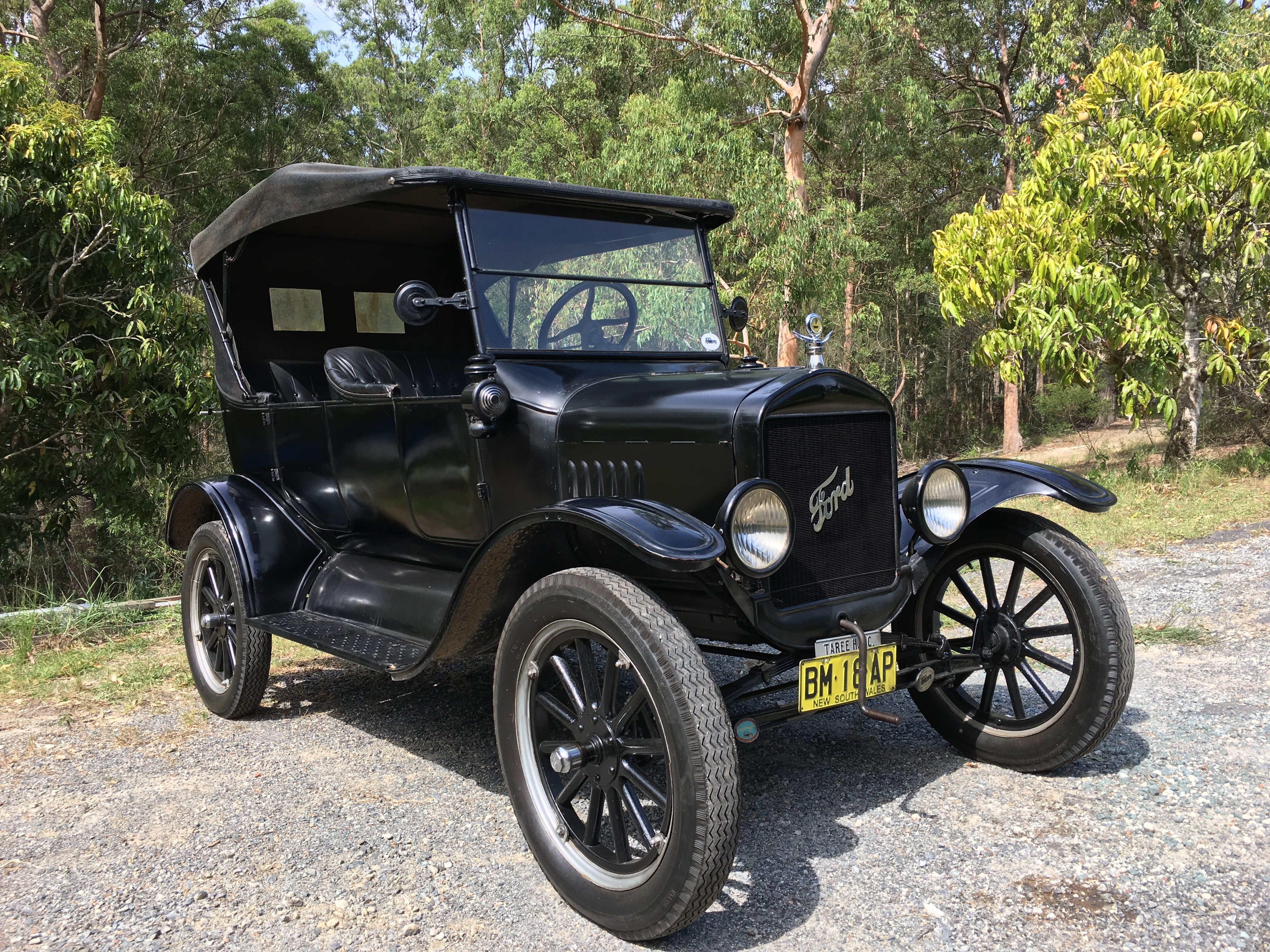
In its early stages the automobile was nothing more than a flex for the ultra-wealthy: opulent, exorbitantly priced, and by and large unobtainable for the common man. Every American kid knows what happens next: Henry Ford enters the picture with a practical, no frills mass-produced tool for the everyman. Ford turned the automobile from a luxury status symbol to the twenty-horsepower beating heart of America.

 | A guest post by
|